You don’t just “manage Workday Learning.”
You architect scalable, data-backed, adoption-driven learning ecosystems that support enterprise transformation, reduce risk, and elevate workforce capability..
the value and results
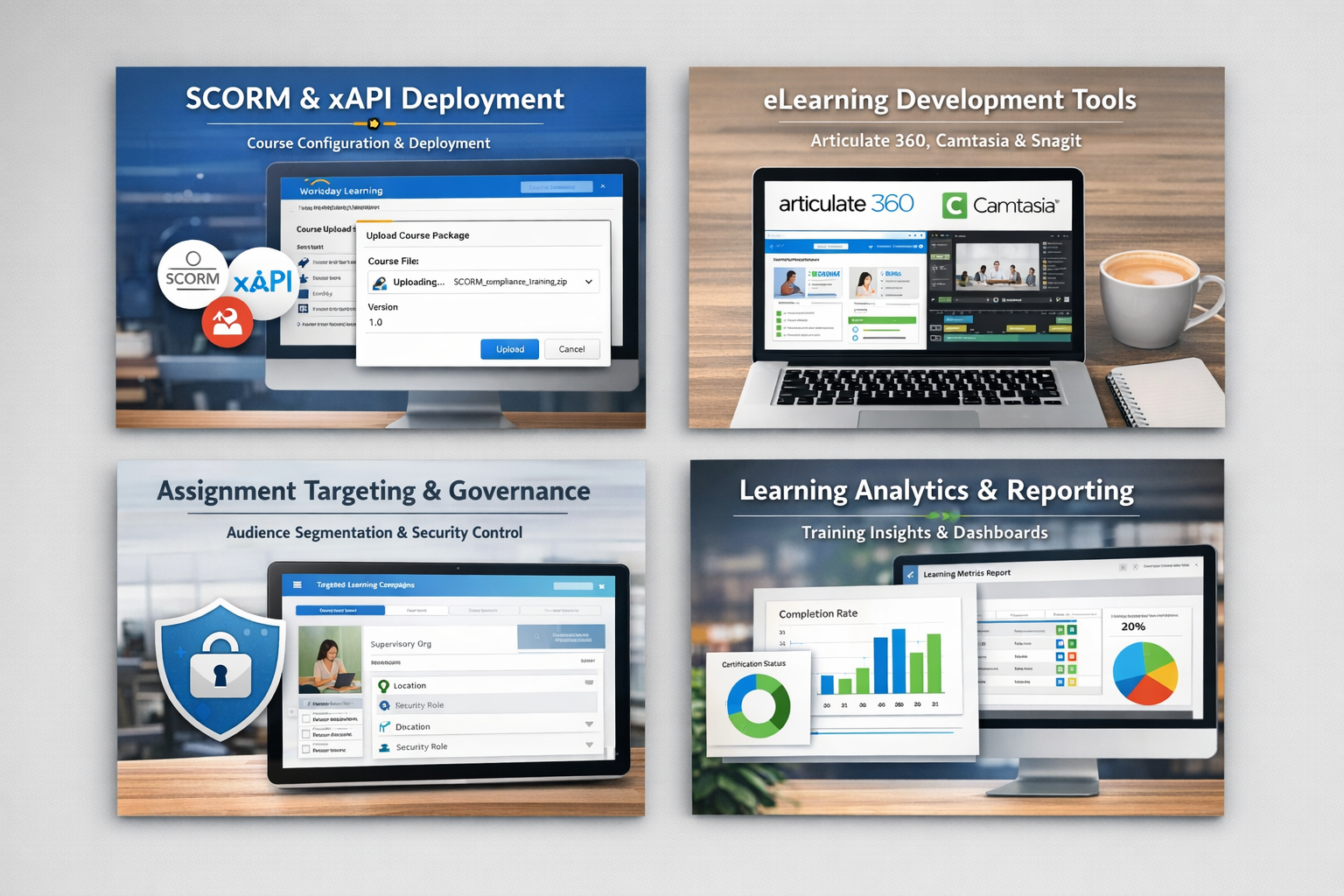
SCORM & xAPI Deployment
1
Course Configuration & Enterprise LMS Implementation
Lead end-to-end deployment of SCORM 1.2/xAPI learning assets into Workday Learning, ensuring accurate tracking, bookmarking, scoring, and completion logic.
Translate legacy LMS or third-party content into Workday-compatible learning objects during system migrations.
Conduct pre-production testing to validate course launch behavior, mobile compatibility, and reporting data integrity.
Configure external content providers (LinkedIn Learning, OpenSesame, etc.) with proper metadata and governance controls.
Design structured course hierarchies (Content → Course → Program → Campaign) aligned to enterprise learning strategy.
Implement automated certification and recertification workflows for regulatory and compliance-driven training.
Troubleshoot launch errors, domain conflicts, and completion tracking discrepancies before go-live.
Develop content governance standards including naming conventions, version control, and archival processes.
Coordinate cutover strategy when transitioning from legacy LMS platforms into Workday Learning.
What this means for leadership:
You ensure learning deployment is audit-ready, technically stable, and scalable across a multi-state or global workforce.
e-Learning Development Tools
2
Instructional Design + Digital Learning Engineering
Design interactive, role-based eLearning modules using Articulate Storyline and Rise aligned to configured Workday business processes.
Develop system simulation scenarios allowing managers to practice real workflow actions before go-live.
Produce microlearning video content (2–5 minute system walkthroughs) using Camtasia to support just-in-time learning.
Create scenario-based knowledge checks tied to measurable competency outcomes.
Convert instructor-led training into LMS-ready digital programs with SCORM tracking functionality.
Develop annotated quick-reference guides and job aids using Snagit for visual reinforcement.
Ensure ADA accessibility compliance (closed captions, alt text, contrast standards).
Apply adult learning theory and change management principles to increase retention and adoption.
Build blended learning programs (ILT + digital + reinforcement assets).
What this means for leadership:
You don’t just create training. You engineer behavioral change that aligns with system functionality and business performance.
Assignment Targeting & Governance
3
Audience Segmentation, Security & Learning Automation
Configure dynamic audiences based on supervisory organization, job profile, cost center, location, or security role.
Build automated learning campaigns for onboarding, compliance, leadership development, and certification cycles.
Establish escalation workflows for overdue training with automated manager notifications.
Align learning eligibility rules with Workday security configuration to ensure proper content visibility.
Create structured onboarding learning paths (Day 1 / 30 / 60 / 90 milestone programs).
Develop a governance model defining content ownership, approval workflows, and lifecycle management.
Partner with HRIS and Security teams to ensure proper domain-level access controls.
Implement cohort-based program enrollment for leadership academies.
Monitor audience logic pre- and post-go-live to prevent assignment gaps.
What this means for leadership:
You build a structured, automated learning environment that reduces manual oversight and increases accountability.
Learning Analytics & Reporting
4
Executive Dashboards & Data-Driven L&D Strategy
Design custom Workday Learning dashboards tracking completion rates, overdue metrics, and program adoption.
Build calculated fields to measure time-to-completion and compliance cycle performance.
Provide executive-level reporting for CHRO and HR leadership to inform strategic workforce development.
Analyze course engagement data to refine content and reduce drop-off rates.
Monitor certification expiration trends to prevent audit findings.
Track manager assignment effectiveness and participation metrics.
Integrate Learning data with Talent and Performance modules for development alignment.
Identify learning gaps based on role or organizational trends.
Develop quarterly training effectiveness summaries for executive review.
What this means for leadership:
You transform L&D from a compliance function into a measurable performance driver.
Learning & development LEADER